Queen Mattress Dimensions Guide (Size, Room Fit & Tips)
A queen mattress is one of the most common sizes people compare when moving up from a Double/Full bed or setting up a primary bedroom. Size matters because it affects floor space, bedding, bed-frame compatibility, and whether the mattress can get through your doorway or stairwell. This guide is for couples, single adults who want more room, and anyone planning a guest room or apartment setup. One common misunderstanding is assuming a queen and a double mattress are the same size. At Furniture Spot & Mattress Outlet in Halifax, we regularly help shoppers compare queen mattresses, bed frames, and foundations when planning bedroom layouts.
What are standard queen size mattress dimensions in Canada?
In Canada, a standard queen mattress is commonly listed at 60 inches wide by 80 inches long. Some Canadian retailers round the metric size a little differently, so you may see 152 cm to 152.5 cm wide and 203 cm to 203.5 cm long in product listings. That small difference is normal and usually comes from rounding, not from a major size change.
A simple way to think about it:
-
Width: 60 in (about 152.4 cm)
-
Length: 80 in (about 203.2 cm)
Mattress brands can vary slightly, so always check the listed dimensions on the product page before buying. Published size charts are often rounded, and tolerances do happen.
How does a queen compare to other common mattress sizes?
A queen is larger than a Double/Full and smaller than a King. That makes it a common middle-ground choice for people who want more sleeping space without taking up as much room as a king-size setup. Canadian retailers commonly list these standard sizes as follows.
| Mattress Size | Inches (W × L) | Approx. cm (W × L) |
|---|---|---|
| Twin / Single | 38 × 75 | 96.5 × 190.5 |
| Double / Full | 54 × 75 | 137.2 × 190.5 |
| Queen | 60 × 80 | 152.4 × 203.2 |
| King | 76 × 80 | 193.0 × 203.2 |
What changes when you move from a Double/Full to a Queen:
-
You gain 6 inches of width
-
You gain 5 inches of length
That extra width can matter if two people share the bed, and the extra length can matter if one sleeper is taller. Because a queen mattress is larger than a Double/Full, it usually requires a queen bed frame or queen foundation designed for that size.
Who is a queen mattress usually a good fit for?
A queen size is often considered a practical option for:
-
Couples who want more room than a Double/Full
-
Single adults who prefer more personal space
-
Primary bedrooms where a king may feel too large
-
Guest rooms that need a more flexible size
If you share the bed, consider motion transfer and personal space. Mattress size helps, but the feel of the mattress also matters. If two people sleep very differently, a larger size or a different mattress type may still be worth comparing.
A queen can work well in many homes, but it is not automatically the right size for every room. The room layout, dresser placement, and walking space matter just as much as the mattress dimensions.
What room size works best for a queen mattress?
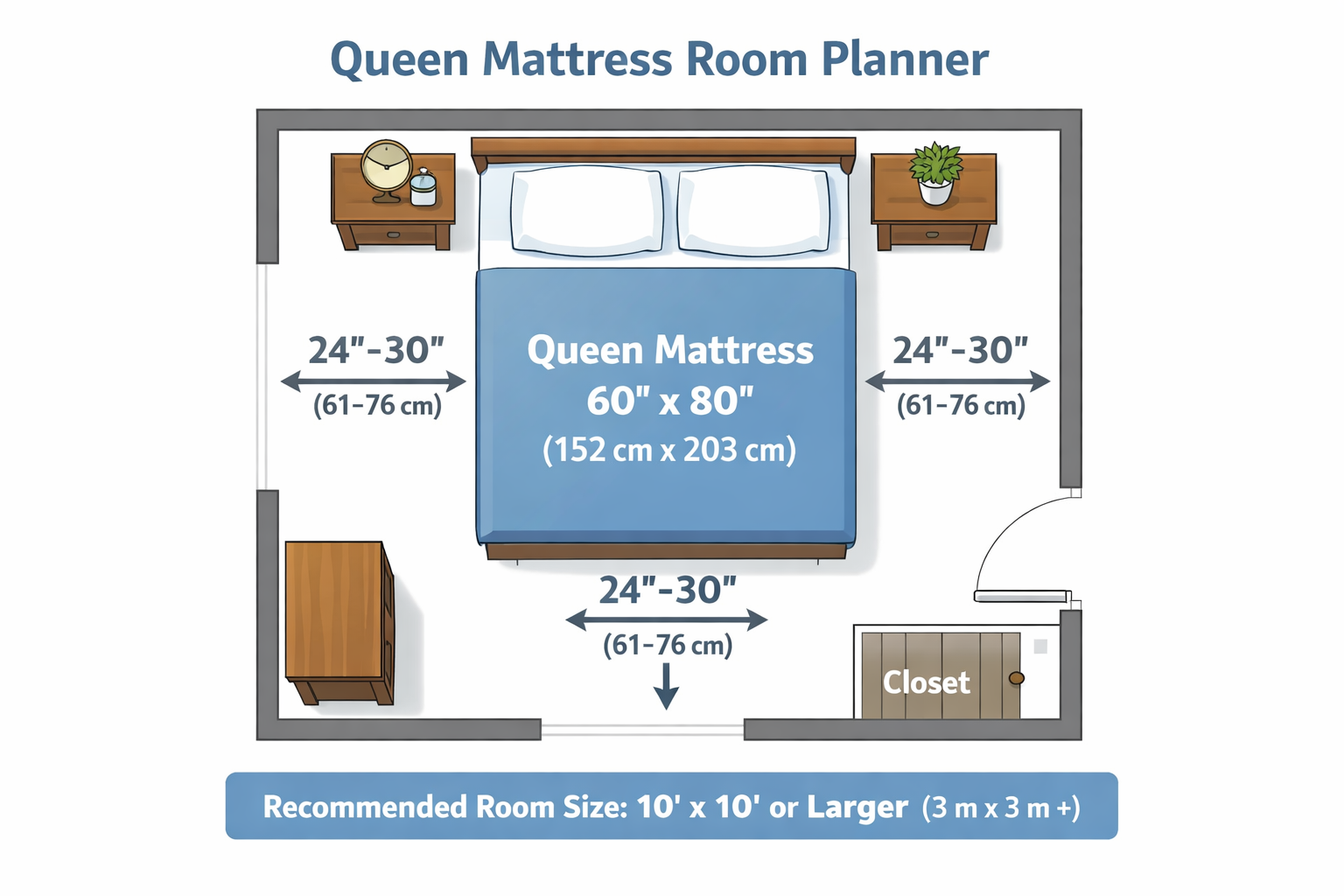
A standard queen mattress is 60 × 80 inches, but the mattress is only part of the footprint. Once you add a headboard, frame rails, and bedside tables, the setup takes more space than the mattress size alone.
A practical planning rule is to leave walking space around the bed where possible. If your room is small, plan walking clearance on both sides. That makes it easier to open drawers, make the bed, and move around without the room feeling cramped. In Halifax apartments and older homes, delivery paths like staircases and tight hallways can make mattress access just as important as room size.
Before buying, think about:
-
Space on the left side of the bed
-
Space on the right side of the bed
-
Clearance at the foot of the bed
-
Whether closet doors, room doors, or dresser drawers will still open fully
In smaller rooms, a queen can still work, but the layout needs more care. In tighter spaces, a platform bed with a simpler frame profile may help reduce bulk around the mattress.
What should you measure before buying a queen mattress?
This is where many buyers make mistakes. They measure the room, but forget the path into the room.
Before buying, measure your doorway, hallway turns, and stairs. This is especially important in apartments, older homes, basements, and tight upper-floor layouts.
Use this checklist:
-
Bedroom width and length
-
Door opening width
-
Hallway width
-
Tight corners or stair landings
-
Ceiling height over stairs, if the path is narrow
-
Elevator dimensions, if you live in a building
Also measure the bed frame opening, not just the old mattress. A frame labelled “queen” should match queen dimensions, but product builds can vary slightly.
If you are replacing only the mattress and keeping the frame, confirm the inside frame measurements before ordering.
Does a queen mattress need a queen bed frame and foundation?
Yes, the mattress should match the frame size. A standard queen mattress is made to go on a queen-size frame or queen-size foundation.
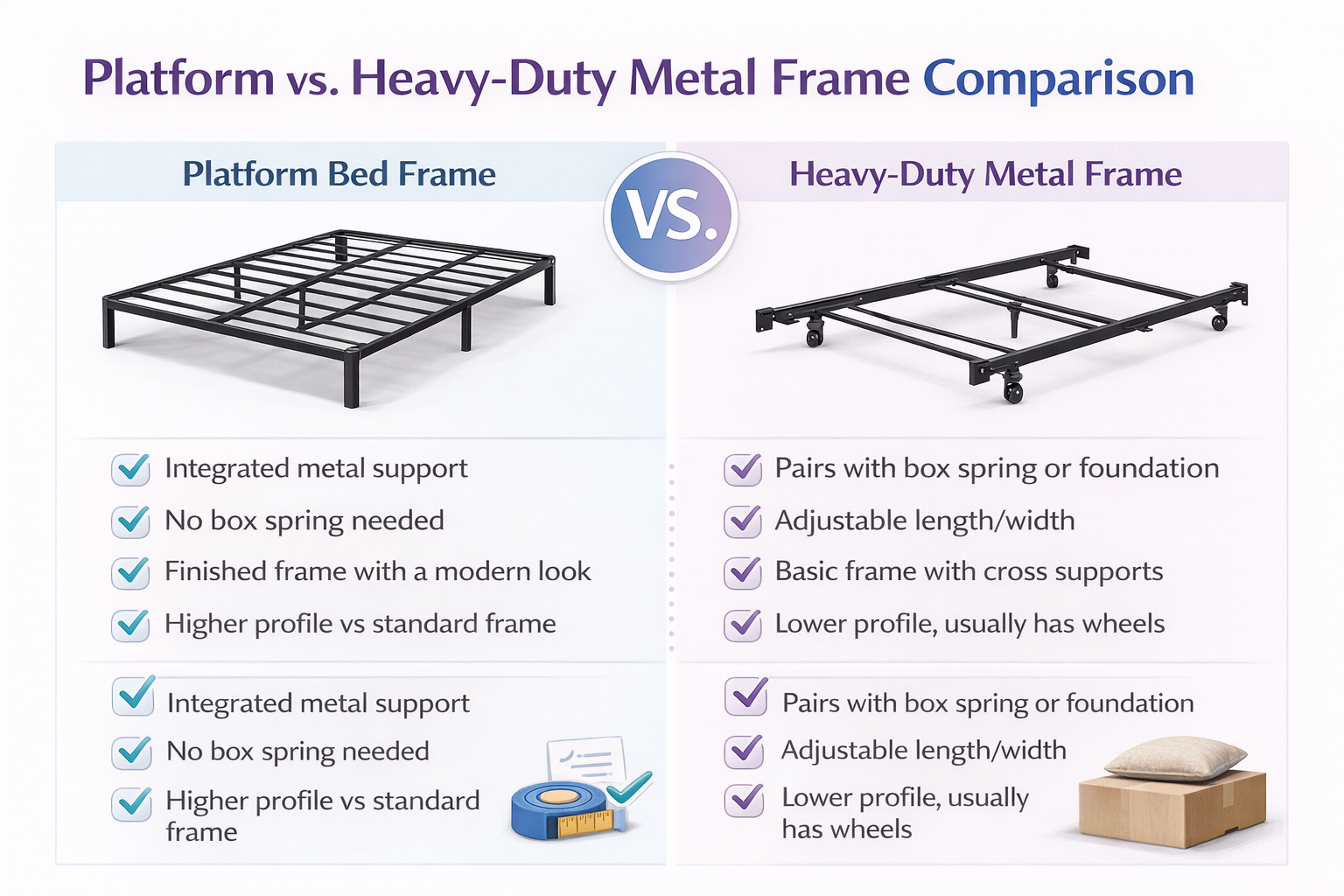
Whether you need a box spring depends on the frame. Some setups use slats or platform support, while others are built around a traditional frame-and-foundation design. Furniture Spot’s own bedding pages also separate queen mattresses, queen bed frames, queen box springs, and metal frames, which reflects how these pieces are typically matched by size.
If you use a platform bed, confirm slat spacing and support requirements. Not every mattress works the same way on every support system.
A few practical points:
-
A queen mattress needs a queen-size frame
-
A queen box spring needs to match the mattress size
-
A metal frame may support a box spring and mattress, depending on the design
-
A platform bed may not need a box spring, depending on the build
Furniture Spot’s queen box spring collection also notes split queen options, which can be useful in tighter stairways or access points.
Are all queen mattresses exactly the same size?
Not always, at least not in the way product pages display them.
The standard is still queen, but you may see:
-
Minor rounding differences in cm
-
Small manufacturing tolerances
-
Slight differences in finished edge shape or cover thickness
-
Special versions like split queen or queen RV, which are not the same as a standard queen
This is why it helps to read the product dimensions and the support requirements together. A queen label tells you the general class of the mattress, but the listed measurements still matter when fitting sheets, foundations, or tight spaces.
What bedding fits a queen mattress?
A standard queen mattress typically uses:
-
Queen fitted sheets
-
Queen flat sheets
-
Queen mattress protector
-
Queen duvet or comforter, depending on your preferred overhang
If the mattress is especially deep, standard fitted sheets may not sit well. In that case, the mattress depth matters just as much as the width and length. When buying bedding, check:
-
Mattress height
-
Pocket depth of fitted sheets
-
Whether the protector is made for standard or deep-profile mattresses
This is a common mismatch point, especially when upgrading from an older mattress to a thicker new one.
FAQ
Is a queen bigger than a double in Canada?
Yes. A queen is typically 60 × 80 in, while a Double/Full is typically 54 × 75 in, so the queen is wider and longer.
What is the size of a queen mattress in cm?
A standard queen is about 152.4 cm × 203.2 cm, though some retailers round this to 152 cm × 203.5 cm or 152.5 cm × 203.5 cm.
Can a queen mattress fit in a small bedroom?
Sometimes, yes, but it depends on the full layout, not just the mattress footprint. You need to account for bed frame size, walking clearance, and furniture placement.
Do I need a box spring with a queen mattress?
Not always. It depends on the frame and support system. Platform beds, slatted frames, and traditional metal frames can have different support requirements.
Can I use a queen mattress on a double frame?
No. The sizes are different, so the fit will be incorrect and the support will not be reliable.
What if my staircase is tight?
Measure access before ordering. In some cases, split foundations can help with narrow entries. Furniture Spot’s queen box spring category notes split queen options for tighter stairways.
Reality Check
Common mistakes people make:
-
Assuming queen and double are close enough to swap
-
Measuring only the room, not the doorway or stairs
-
Forgetting the bed frame adds to total footprint
-
Buying queen sheets without checking mattress depth
-
Assuming every queen-labelled product has identical rounded metric dimensions
Limitations and what can go wrong:
-
The mattress may fit the room on paper but still feel bulky once furniture is in place
-
Delivery access can be harder than expected in tight stairways or apartment buildings
-
A new queen may require new sheets, a new frame, or a new foundation
-
Comfort expectations can be off if buyers focus only on size and ignore support type
Who a queen is best for:
-
Couples who want more room than a Double/Full
-
Single sleepers who want extra width
-
Primary bedrooms with moderate floor space
-
Guest rooms where flexibility matters
Who may want to avoid it:
-
Very small bedrooms with tight walking clearance
-
Shoppers trying to reuse a smaller frame
-
Homes with difficult access and no plan for delivery path
-
Buyers who really need maximum width and should compare a king instead