Bunk Bed Safety and Room Fit: What to Check
Work through this list before you order, not after the box arrives. Bunk beds are one of the few pieces of furniture where getting a measurement wrong creates a genuine safety issue rather than an inconvenience.
Ceiling height above the top mattress
Measure from the floor to the ceiling, then subtract the height of the upper bunk's sleeping surface and the thickness of the mattress going on it. You want a clear space above the top mattress that lets a child sit up without hitting their head. Around 30 inches is the practical minimum, and more is better.
This catches people in older Halifax homes with sloped attic ceilings and in basement suites where the ceiling drops under a duct run. Check the height at the exact spot the bed will stand, not in the middle of the room.
Guardrails on both sides
The upper bunk needs a guardrail on both long sides, including the side against the wall. Beds sold with a single rail assume the wall does the work, and it does not; children shift in their sleep and a gap between mattress and wall is a trap.
Health Canada's guidance is specific: the top of the guardrails must sit at least 12.7 centimetres, or 5 inches, above the top of the mattress, on all sides. That is a measurement taken against the mattress, not the bed frame, which is why the next section matters as much as this one.
Worth knowing: Canada has no mandatory federal bunk bed regulation. Health Canada recommends buying a bed certified to a recognised standard, ASTM F1427, and has issued recalls against beds that failed it. Look for that marking on the label or the box.
Mattress thickness is a safety spec, not a preference
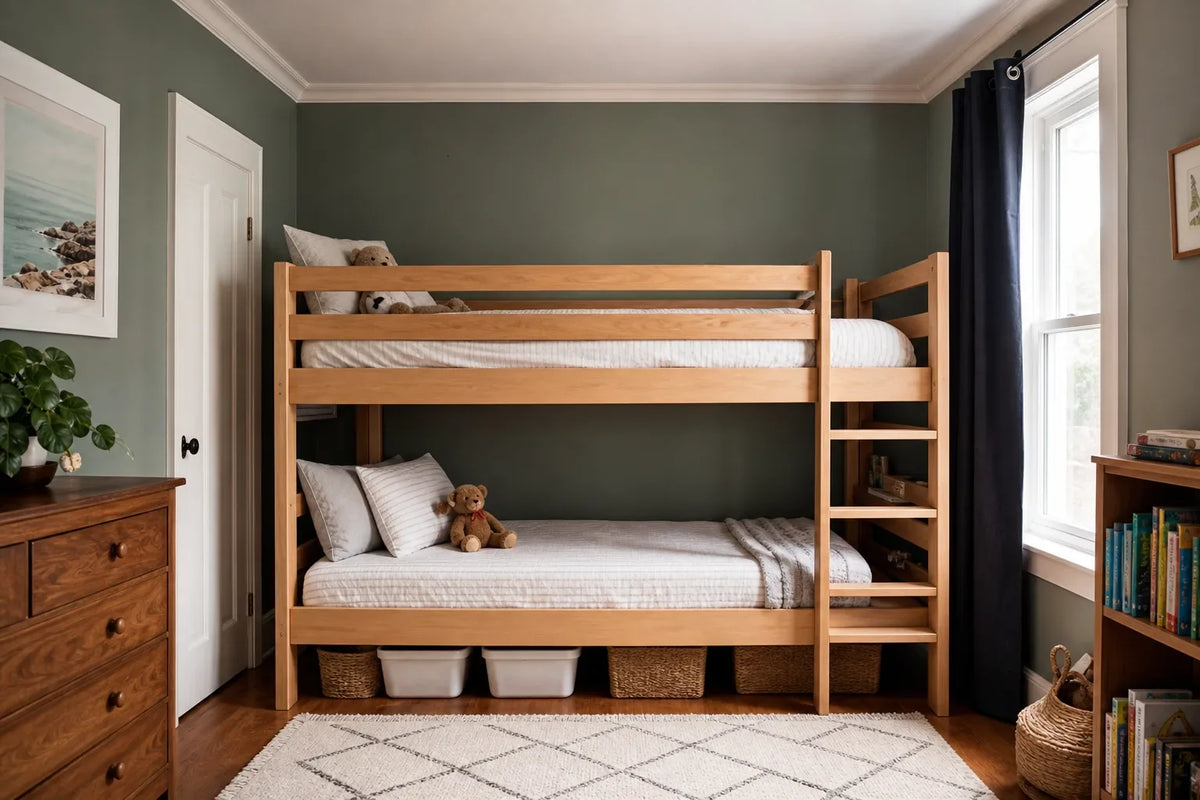
Every bunk bed states a maximum mattress thickness for the top bunk, and the arithmetic is the reason. Measure your guardrail height above the slats and subtract 5 inches; what is left is your maximum mattress thickness. A frame with 11 inches of guardrail takes a 6-inch mattress. Put a 10-inch pillow top on it and you have an inch of rail left, which stops nothing.
Buy the mattress to the bed's specification. In practice that puts most upper-bunk mattresses in the 5 to 6 inch range. We stock bunk beds from around $389 to $1,299 and can tell you the guardrail height on any frame on the floor before you choose a mattress for it.
Gaps and openings
Check the spaces in the guardrail, the ladder, and the headboard and footboard structure. Health Canada's guidance is that openings above the mattress support system should be under 8.4 centimetres, about 3.3 inches. Openings need to be either small enough that a child's body cannot pass through or large enough that a head cannot become wedged; the dangerous range is the middle.
One more that almost nobody checks: corner posts and ladder rails should not stand more than 5 millimetres above the guardrails or end panels. Anything taller catches clothing, and that is a strangulation risk rather than a fall risk.
This is also the main argument against buying a used bunk bed, or a very old one, or one assembled from parts of two beds. Older frames predate current requirements, and missing hardware gets substituted with whatever was in the drawer.
Age of the child in the top bunk
Standard guidance is that children under six should not sleep on an upper bunk. This is not about capability. It is about a half-awake child navigating a ladder at 2 a.m.
If you have a four-year-old and a seven-year-old, the four-year-old is on the bottom, and the bunk is a purchase for a room that will work for the next decade rather than for right now.
The ladder and the route to it
Look at where the ladder lands. It needs floor clearance in front of it, not a dresser corner or a radiator. In small bedrooms the bunk usually goes in a corner, and the ladder ends up two feet from a wall. Walk the route yourself before you commit to a layout.
Angled ladders are easier for young children than vertical ones and take more floor space. Stairs with built-in drawers are easier still and take considerably more. A twin-over-twin frame occupies roughly the same floor area as a single twin bed, around 42 by 78 inches, and you want about 30 inches clear on the ladder side. In the second bedrooms common in older Halifax flats, the drawer-stair option often will not fit alongside a dresser once you allow for that.
Assembly and re-tightening
Bunk beds loosen. Children climb, jump, and treat the frame as playground equipment, and the fasteners work loose over months. Put a reminder in your phone to check every bolt twice a year. It takes ten minutes and it is the single most useful maintenance habit for this piece of furniture.
Assemble it in the room where it will live. A fully built bunk bed does not fit through a standard door frame or around the turn at the top of a staircase.
Weight capacity
Check the rating for the upper bunk specifically, which is lower than the lower bunk. If an adult will ever sleep up there, a guest, a parent settling a child, confirm the number covers it. Many bunk beds do not.
Bring your ceiling height and the room dimensions when you come in. We will not sell a bunk into a room that cannot take one safely.
bunk beds and kids' beds. Related: why furniture fasteners loosen over time and best bed frame for small bedrooms.