What Size Is a Twin Bed?
A twin bed is one of the most common small-bed options, so knowing the exact size helps with room planning, frame matching, bedding, and delivery access. This applies to parents setting up a child’s room, shoppers furnishing a guest room, and renters working with a smaller bedroom in Halifax and surrounding HRM areas.
At Furniture Spot & Mattress Outlet in Halifax, twin and single beds are among the most requested compact sizes, especially for kids’ rooms and smaller layouts. One common misunderstanding is that every store lists twin size exactly the same way. Most Canadian charts use the same standard footprint, but some retailers round the width differently in their product guides.
What is the standard size of a twin bed?
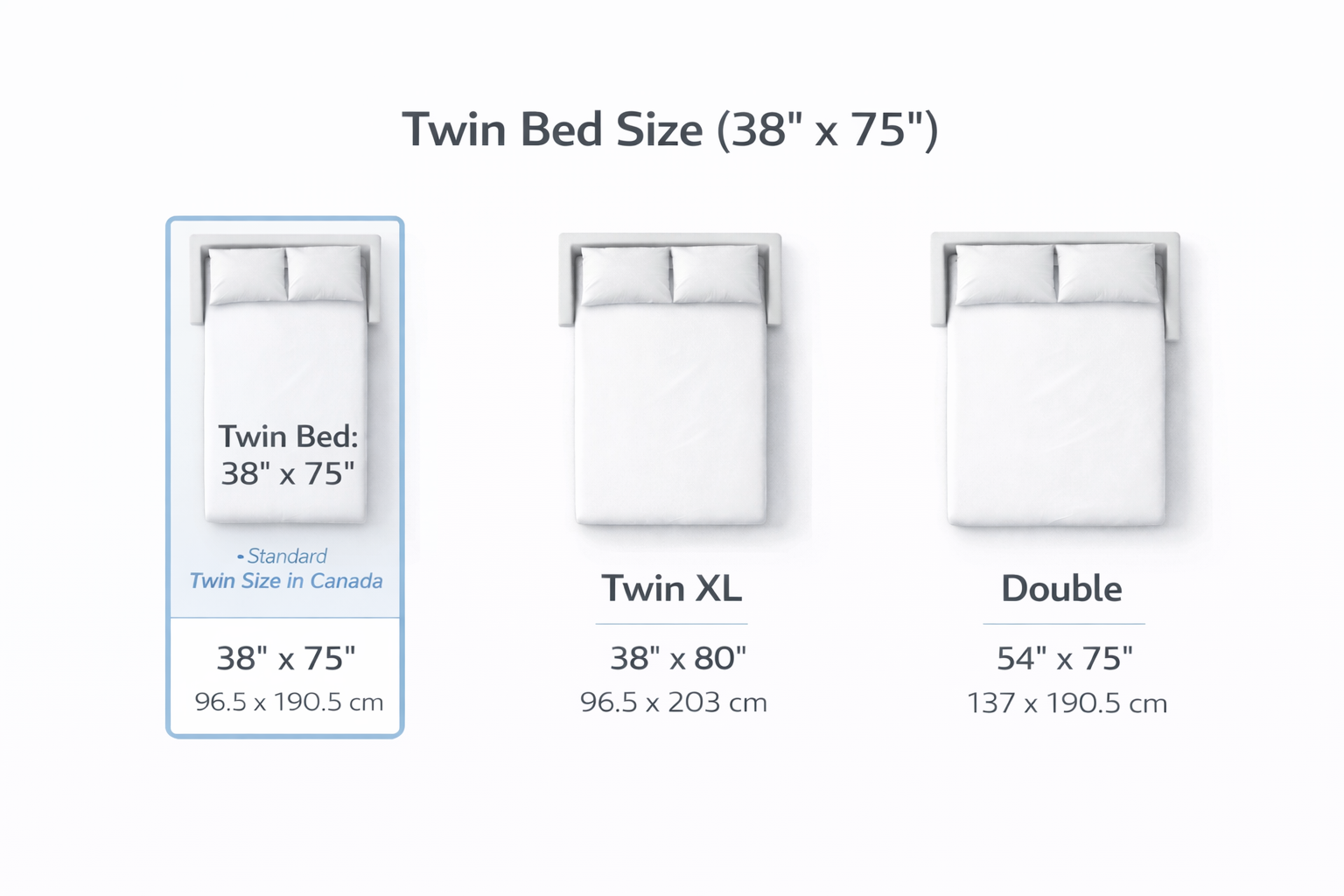
The standard twin bed size is usually listed as 38 inches wide by 75 inches long in current Canadian size charts. In centimetres, that is 96.5 cm x 190.5 cm. In feet, that is 3 feet 2 inches x 6 feet 3 inches. Many standard Canadian size charts use this measurement, and Furniture Spot & Mattress Outlet’s current bed-size guides list twin at 38" x 75".
| Bed Size | Dimensions (inches) | Dimensions (cm) | Dimensions (feet) |
|---|---|---|---|
| Twin / Single | 38" x 75" | 96.5 x 190.5 cm | 3'2" x 6'3" |
Some retailers round twin size to 39" x 75" instead of 38" x 75". Furniture Spot’s “Choosing the Right Bed Size for You” uses 39 x 75 inches (99 x 190.5 cm), while its other recent size guide uses 38" x 75". That is why it is smart to check the exact product page before buying. Tolerances and rounding happen.
Is a twin bed the same as a single bed in Canada?
Yes. In Canada, twin and single usually mean the same standard size. Furniture Spot’s recent guides use both names together, such as “Twin (Single) Bed.”
That means if you see “single mattress,” “single bed,” or “twin bed,” you are usually looking at the same size category unless the listing clearly says Twin XL or another non-standard variation.
How does a twin compare to a Twin XL and a Double?
A twin and a Twin XL have the same width, but the Twin XL is longer. A standard twin is 38" x 75", while a Twin XL is 38" x 80". A Double/Full is wider at 54" x 75". Furniture Spot’s current bed-size charts show those same basic comparisons.
| Size | Dimensions (inches) | Dimensions (cm) |
|---|---|---|
| Twin / Single | 38" x 75" | 96.5 x 190.5 cm |
| Twin XL | 38" x 80" | 96.5 x 203 cm |
| Double / Full | 54" x 75" | 134.5 to 137 x 190.5 cm |
This matters because a twin is mainly chosen for compact spaces, while a Twin XL adds length for taller sleepers and a Double adds more width for one adult. Furniture Spot’s current article for taller sleepers says 75-inch mattresses are often too short for adults over about 5'10", while 80-inch mattresses suit more tall adults.
Who is a twin bed usually best for?
A twin bed is commonly used for children, teens, small guest rooms, and smaller bedrooms. Furniture Spot’s recent size guides describe twin as a compact option for those uses, and its twin/single bed-frame collection is specifically positioned for a kid’s room, guest room, or smaller space.
A twin can also work for one adult in a tight room, but it is a smaller long-term fit than a Double, Queen, or Twin XL. Furniture Spot’s single-mattress guide says twin mattresses are easy to move and work well in compact spaces, which is part of why they are common in smaller homes and guest setups.
What should you measure before buying a twin bed?
Before buying, measure your doorway, hallway turns, and stairs. Even though a twin is smaller than a queen or king, the delivery path still matters, especially if you are buying a full bed frame with a headboard, footboard, or metal side rails. Furniture Spot’s twin/single bed collection specifically tells shoppers to measure the room, stairs, and doorways before choosing.
Use this checklist:
-
bedroom width and length
-
doorway width
-
hallway corners
-
stair landings
-
elevator depth, if you live in an apartment
-
walking space around the bed
-
space for a dresser, desk, or side table
If your room is small, plan walking clearance on both sides. A twin is compact, but the room can still feel crowded once other furniture is added.
Does every twin mattress fit every twin bed frame?
Not always perfectly. The standard category matches, but exact finished dimensions can vary slightly by brand, and the frame itself is often a little larger than the mattress footprint. Furniture Spot’s current twin/single bed collection includes many different frame styles, from simple platform beds to headboard-and-footboard designs, which shows why the outer frame dimensions still need to be checked.
If you use a platform bed, confirm slat spacing and support requirements. Furniture Spot’s twin/single bed collection includes models that say no box spring required, but that depends on the frame design, not just the mattress size.
FAQ
What size is a twin bed in inches?
A standard twin bed is usually 38" x 75" in current Canadian sizing charts.
What size is a twin bed in feet?
A standard twin bed is 3 feet 2 inches wide and 6 feet 3 inches long. That comes from converting 38 inches and 75 inches into feet and inches.
Is a twin bed the same as a single bed?
Yes. In Canada, twin and single usually refer to the same standard bed size.
Is a twin bed big enough for an adult?
It can be for one adult in a small room, but Furniture Spot’s recent taller-sleeper guidance says 75-inch mattresses are often too short for adults over about 5'10". A Twin XL may be a better fit if length is the issue.
Related reading
Reality Check
Common mistakes include assuming every twin listing uses the exact same rounded measurements, checking only the mattress size and not the full frame size, and forgetting to measure the delivery path. Another common issue is buying a standard twin for a taller sleeper when the real problem is mattress length, not width.
A twin bed is usually best for children, smaller guest rooms, and tight layouts where floor space matters. It is a weaker fit for couples, taller adults who need more legroom, or shoppers who want extra personal space. In those cases, a Twin XL, Double, or Queen may make more sense depending on the room.