

Dining Bench vs. Chairs: Measure Table Fit Before You Buy
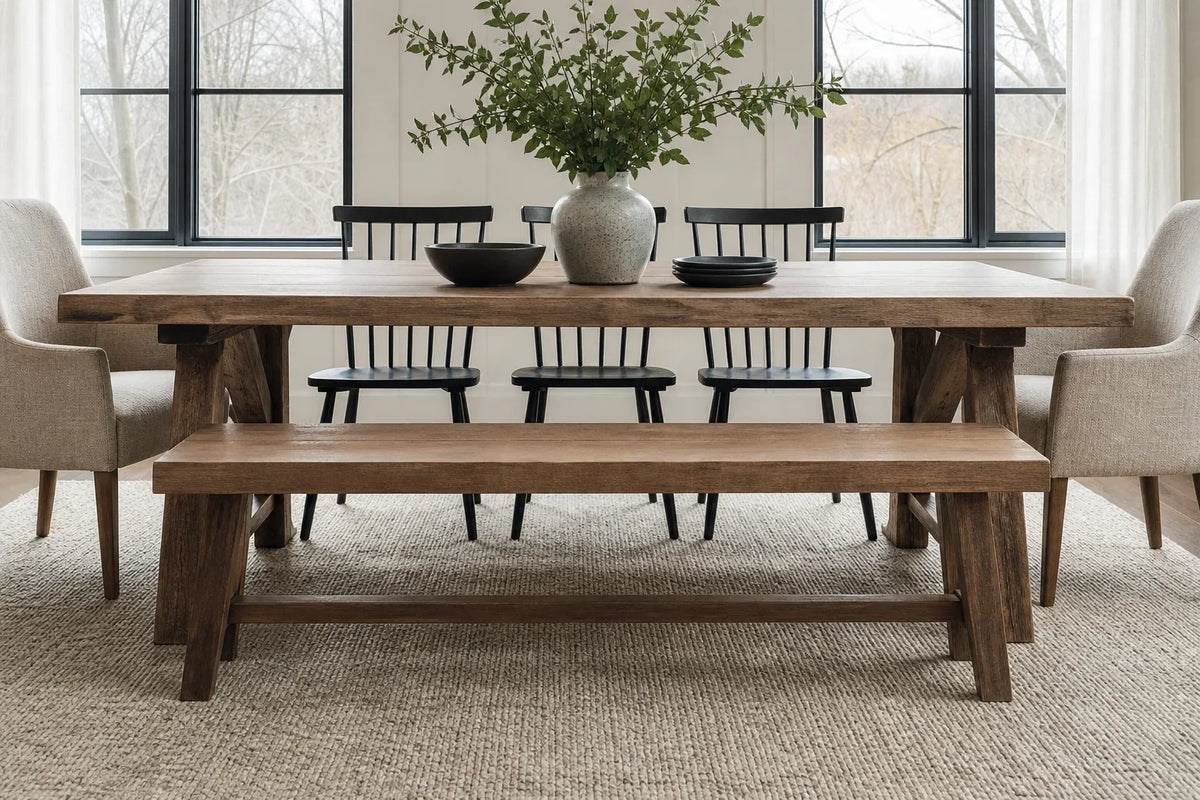
A dining bench can tuck away neatly, but only if its complete frame fits between the table supports. Chairs offer separate access for each diner, while a bench shares one seating surface. Choose by checking the table opening, comfortable seating width and how people get in and out. The tabletop length alone cannot tell you whether a bench will work.
Start with the space between the legs
Record the tabletop length, then measure the narrowest usable opening between the supports. Include angled legs, stretchers and any hardware that projects into the opening. Check at the heights where the bench seat and legs will pass.
Danetti's dining-bench measuring guide distinguishes a full-length bench from one intended to tuck underneath. It also directs buyers to the inside-leg measurement. Those are different layouts, so decide which one you want before shopping.
The bench's seat length may not be its widest dimension. Splayed feet or a projecting back can make the complete piece larger. Ask for overall dimensions as well as seat dimensions.
Worked example: a shorter bench that still does not tuck away
Imagine a table with a 160 cm top, but just 128 cm between the inside faces of its legs. A bench measuring 140 cm overall is shorter than the table, yet 12 cm wider than that opening. It cannot slide straight underneath.
A 118 cm bench would leave 10 cm total, or 5 cm at each end if centred. That is a geometric fit in this hypothetical example, not confirmation that its depth, height or supports are compatible. Test those dimensions separately.
Check the apron, not just tabletop height
An apron is the frame beneath a tabletop. It can reduce the space above the seat even when two tables have the same overall height.
Sit on a comparable bench and check whether your thighs fit comfortably under the lowest obstruction. For upholstered seating, notice how far the cushion compresses with you on it. Also check whether your feet rest comfortably and whether you can reach the table without perching on the front edge.
Use the same test for dining chairs. A visually matching seat is not necessarily a comfortable match for the table.
Seating capacity is more than dividing bench length
A continuous seat does not create unlimited places. The tabletop must still provide usable eating positions, and table legs can occupy the space a person needs for their knees.
Make a full-size seat template or mark the bench length on an existing safe seating surface. Ask the intended users to sit together. Put place settings on the table at the same positions and check elbows, knees and access.
Do not treat this exercise as permission to exceed the bench's stated load limit. Confirm the manufacturer's intended occupancy and load conditions. Where no rating is available, ask before purchasing rather than guessing from the bench's appearance.
Compare daily access
| Your routine | What to test |
|---|---|
| Diners leave the table at different times | Whether the middle person needs others to move |
| Seating sits against a wall | How everyone enters without climbing over the bench |
| The table is used for longer meals | Back support and comfort after more than a brief sit |
| You need floor space between meals | Whether the entire bench actually tucks in |
| A walking route runs behind the seats | The occupied position, not just the stored position |
Chairs are individually movable, but they also need space to pull out. A bench can reduce visible clutter between meals while being awkward when occupied. Test both states before deciding which saves usable space.
Backless, backed or mixed seating?
A backless bench may pass under a table that a backed bench cannot. A backrest can improve the experience for someone who wants support, but adds another dimension to check against walls, windows and the table edge.
A mixed arrangement can be more practical than all benches or all chairs. Put the bench where its users can enter easily and chairs where independent movement matters. Check that end chairs do not collide with bench corners when people turn or pull out.
The Costco dining-room measuring guide also treats seat fit as a separate measurement task. Use published recommendations as starting points, then verify your own furniture together.
Take these measurements shopping
- Tabletop length and width.
- Narrowest support opening along the bench's route.
- Floor-to-apron height and any lower crossbar position.
- Bench overall length, depth and height, including the feet.
- Comfortable occupied position and remaining route behind it.
- Manufacturer load rating and care instructions.
When comparing dining tables, keep the support layout beside the overall dimensions in your notes. A slightly different base can change bench compatibility more than a larger tabletop. Bring both sets of measurements when asking FurnitureSpot about a particular combination.