Dresser, Chest or Tallboy: Which Goes Where
The mistake is buying by capacity. Someone counts drawers, picks the piece with the most, gets it home and discovers it blocks the window, or that it is too tall to see over, or that there is nowhere to set anything down. Capacity is the least useful number on the tag.
These pieces differ by proportion, and proportion is what decides where each one belongs.
| Piece | Shape | Typical use |
|---|---|---|
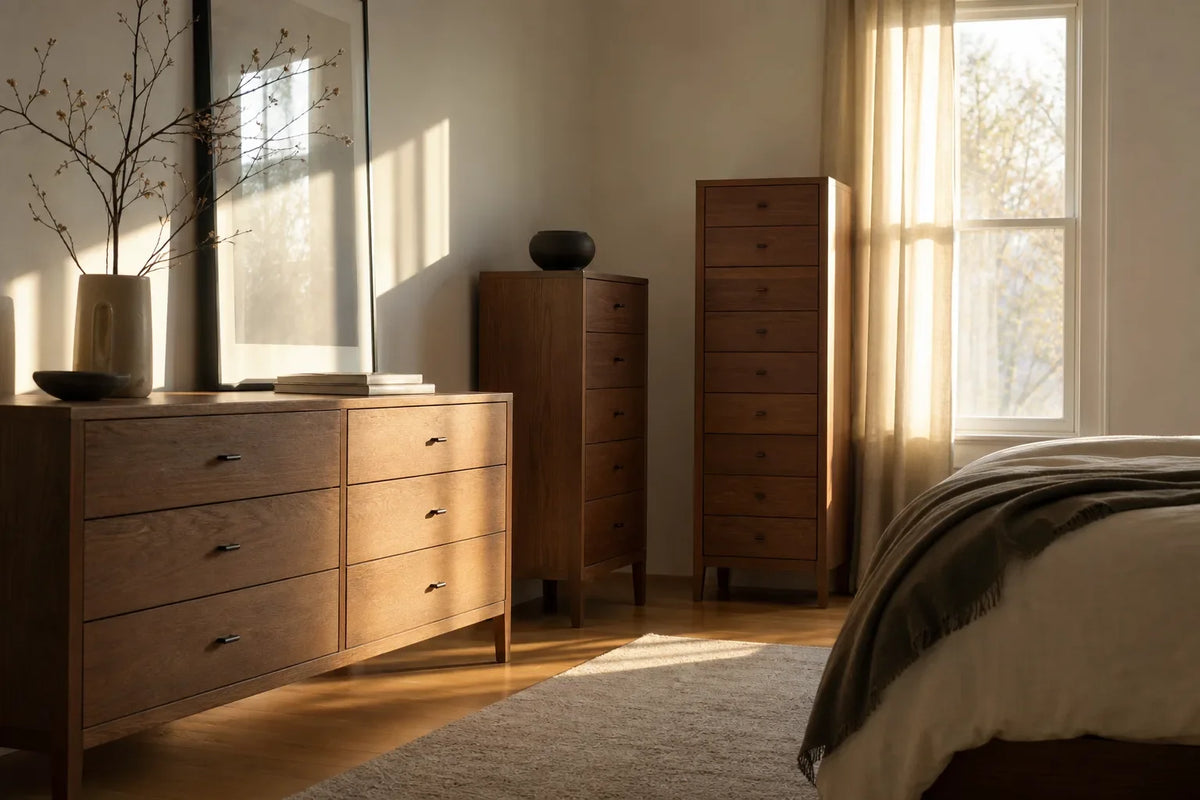
| Dresser | Wide and low, often two drawers across | Main bedroom storage, doubles as a surface |
| Chest of drawers | Narrower, taller, single column | Second bedroom, or alongside a dresser |
| Tallboy | Tall and narrow, often five or more drawers | Tight floor plans where height is free |
| Lingerie chest | Very narrow, many shallow drawers | Small items, fits in leftover wall space |
Height is the real decision
A dresser tops out around waist height, which means you can use the top of it. That surface ends up holding a lamp, a mirror, keys, and everything else, and losing it is the most common regret after buying tall.
A tallboy gives you the same drawer volume in a third of the wall width, and the top is above shoulder height on most people, so it is not a usable surface. In a bedroom where floor space is the constraint and wall space is not, that is a good trade. In a room where you wanted somewhere to put a lamp, it is not.
Chest of drawers sits between the two and is the safe answer when you are unsure.
What actually determines whether it lasts
Drawer construction, not the box. Open a drawer fully in the store and look at the corners: dovetailed or doweled joints outlast stapled butt joints by years. Then push down on the front of the fully extended drawer. If it sags noticeably, the runners are underbuilt and they will get worse under a load of jeans.
Check the drawer bottom too. A thin panel sitting in a groove will bow under weight; a thicker panel or a supported one will not. This is the part people never inspect and the part that fails first.
Also open the bottom drawer and look at whether the piece wants to tip forward. Every tall unit should be strapped to the wall regardless, and any piece with a child in the house is not negotiable on that point.
Pairing it with the room
This pairing question comes up constantly in older Halifax homes, where the bedroom often has no built-in closet at all. If the bedroom already has a wardrobe doing the hanging, you need drawers for folded items only, and a chest is usually enough. If the room has a built-in closet with a shelf, a wide dresser under the window makes better use of the wall than a tall piece that competes with the closet for height.
Several of our bedroom sets include a matching dresser, and the chest is usually a separate add-on rather than part of the set
Open the drawers on our floor models and do the sag test yourself. It is the fastest way to tell two similar-looking pieces apart.
dressers and chests. Related: why drawer bottom strength is often overlooked and why component matching matters in bedroom sets.