Sizing a Desk for a Spare Bedroom
Forty-eight inches wide and twenty-four deep is the smallest desk most people can work at full time without feeling cramped. Below that you start stacking things, and a desk you stack things on is a desk you stop using properly.
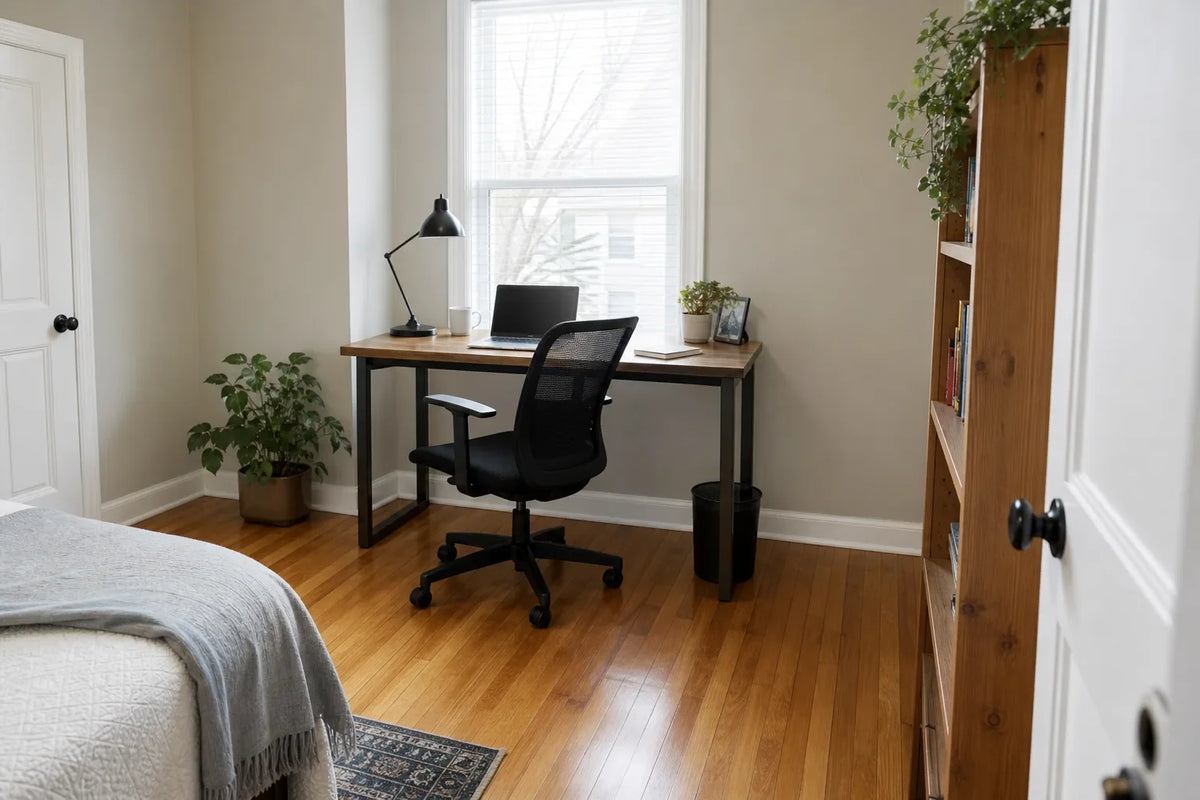
The spare bedroom is where most home offices in this city ended up, and spare bedrooms in older Halifax houses are small. So the question is not what desk you want, it is what the room will give you.
The numbers that matter
| Dimension | Workable | Comfortable |
|---|---|---|
| Desk width | 42 in | 55 to 60 in |
| Desk depth | 24 in | 28 to 30 in |
| Desk height | 29 to 30 in standard, sitting | |
| Knee clearance width | 24 in | 30 in |
| Clearance behind chair | 36 in | 42 in |
Depth is the one people cut and should not. Twenty-four inches is enough for a laptop and not enough for a monitor, because a monitor needs to sit roughly an arm's length from your eyes and a shallow desk puts it too close. If depth is fixed by the room, a monitor arm reclaims four to six inches by removing the stand's footprint, and it is the cheapest fix in this entire article.
Two monitors need 55 inches minimum. There is no clever arrangement that beats this.
The clearance behind you
The 36 inches behind the chair is not optional and it is the measurement that eliminates most desk positions in a small room. You need to roll back and stand up. Against a wall, with a bed three feet away, you will discover that the chair hits the bed and you climb out sideways every time.
Measure the standing zone on the floor with tape before you order anything. It takes five minutes and it decides which wall the desk goes on.
Room shapes that change the answer
A corner desk uses the least useful part of a small room and gives you the most surface for the footprint. It also puts you facing a corner, which some people find claustrophobic after a week.
A desk under a window gives you daylight and glare on your screen at exactly the wrong time of afternoon. In a west-facing Halifax room this is worse than it sounds between April and September. Perpendicular to the window is usually the right compromise.
If the room has a sloped ceiling, and third-floor rooms here often do, measure the height at the desk edge nearest the slope while seated upright. People buy the desk and then discover they cannot sit up straight at it.
We carry a limited desk range rather than a full office line, so check availability before you plan a room around one
If the room also has to be a guest room
Then the desk cannot be the piece that folds away, because you use it daily and the guest uses the bed twice a year. Make the bed the flexible piece. A daybed or a folding frame keeps the desk permanent, which is the correct priority.
Bring the room dimensions in. Fitting a desk into a small Halifax second bedroom is a measurement problem more than a shopping problem.
desks and home office furniture. Related: why a dining chair fails as a work chair and where guests sleep in a one-bedroom.