Extendable Dining Tables: Worth It or Not
Extendable dining tables promise the best of both worlds — a compact table for everyday use and extra length for guests. Whether that promise holds up depends on how often you actually host, and how well the mechanism is built.
How Extension Mechanisms Actually Work
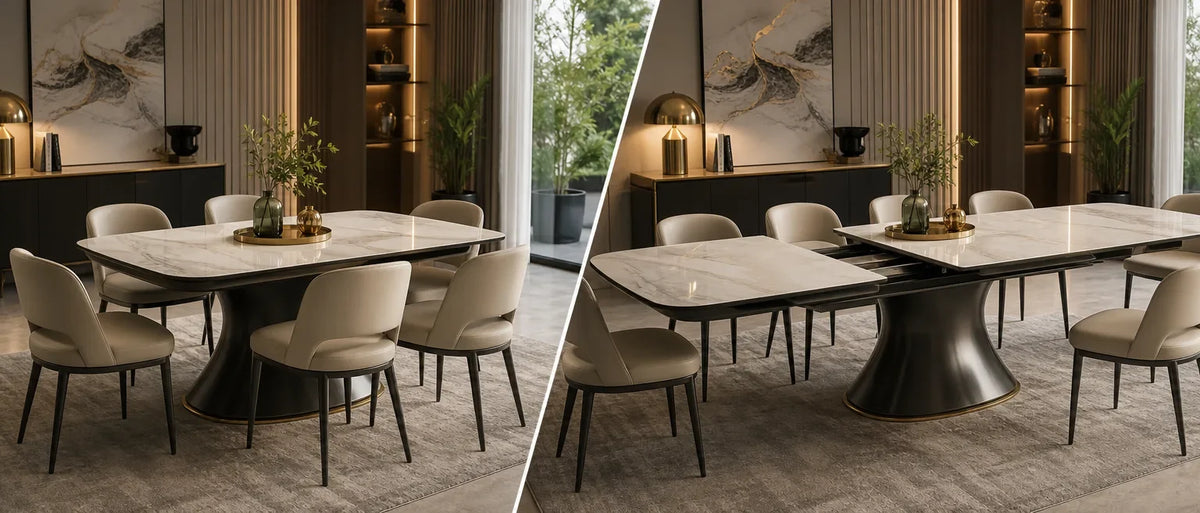
Most extendable tables use one of two systems: a butterfly leaf that folds up and stores inside the table, or a separate leaf you insert manually by pulling the halves apart. Butterfly mechanisms are more convenient day to day; separate leaves tend to be sturdier long-term since there are fewer moving parts under load.
When You'll Actually Use the Extra Leaf
Be honest about your hosting frequency. If you host six or more people only a few times a year, an extendable table earns its keep — you get a compact daily table without needing a separate large table stored somewhere. If you host large groups monthly or more, a fixed larger table may serve you better with less wear on the mechanism.
Durability of Extension Mechanisms Over Time
Slide mechanisms take repeated stress at the same connection points, so the material underneath matters. Solid wood and metal-reinforced slides hold up considerably longer than particleboard-based mechanisms, which can loosen or stick after a few years of regular use.
Extendable vs Fixed: A Real Cost Comparison
Extendable tables typically cost 15–30% more than a fixed table of the same base size, due to the added hardware. If you rarely use the extension, a fixed table in a slightly larger size is often the better value.
Who Should Skip the Extendable Option
If you have young children who tend to lean or climb on furniture, the moving parts in an extension mechanism are more vulnerable to accidental damage than a solid fixed table. In that case, a simple fixed table from our dining table collection is the more durable everyday choice.