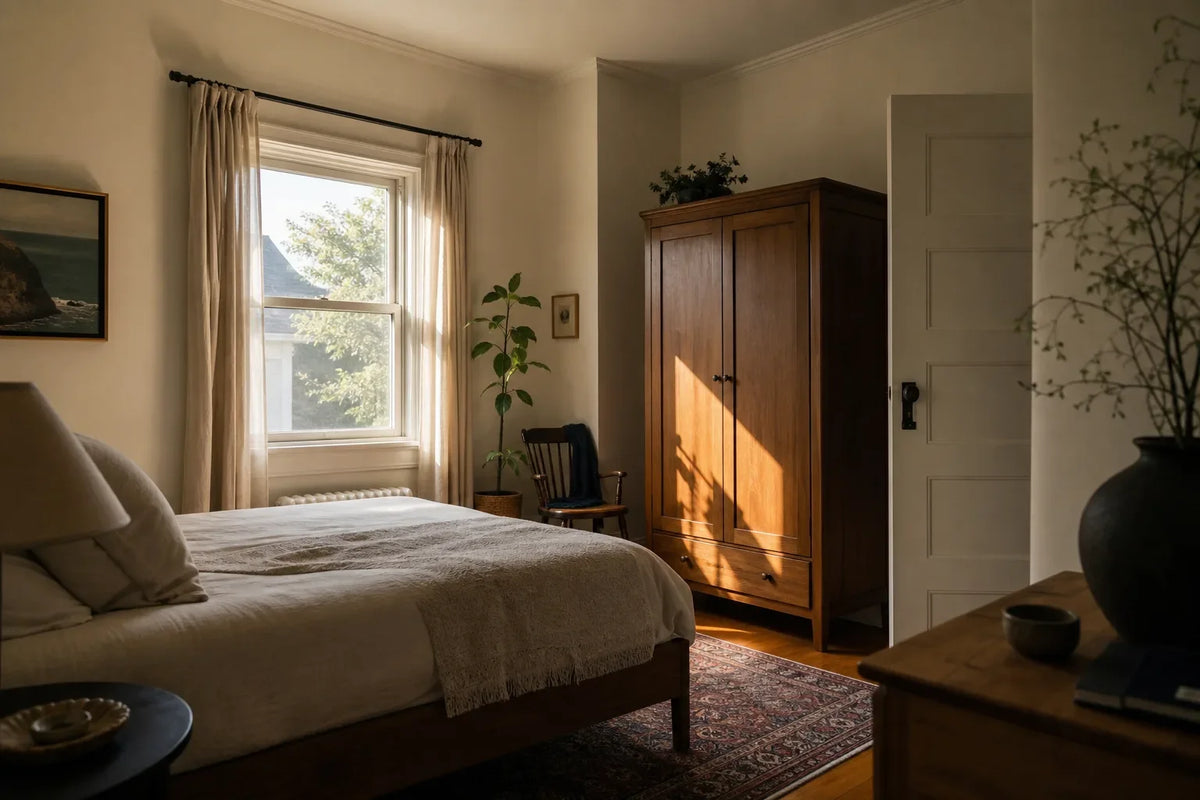
Furnishing a Bedroom That Has No Closet
People treat a closet-less bedroom as a defect. In most of Halifax's older housing stock it is not a defect, it is the original design. Houses built before closets became standard were furnished with freestanding pieces, and the wardrobe did the job the built-in closet does now. The room is not missing something. It is missing the furniture it was drawn around.
That reframing changes what you shop for. You are not looking for a workaround. You are looking for the piece the room was designed to hold.
Wardrobe, armoire, or an open system
A wardrobe is a tall cabinet with a hanging rail inside, usually with a shelf above and sometimes a drawer below. An armoire is the same idea with more decorative intent and often more interior fitting. In practice the words get used interchangeably on price tags, so ignore the name and look at what is inside.
The number that decides everything is hanging height. Shirts and folded trousers need roughly 40 inches of clear drop. Dresses and long coats need closer to 60. A wardrobe with a single rail at mid-height gives you the first and not the second, and if you own long coats you will find out in week two.
Open rail systems cost a fraction of a wardrobe and put your clothes on display permanently. In a bedroom you keep tidy, that is fine and looks deliberate. In a bedroom that is also where laundry lands, it looks like laundry.
The measurement that catches people
A wardrobe is tall and rigid. Measure the diagonal of your doorway and the diagonal at the turn of your staircase, not just the widths. A 78-inch wardrobe carcass will not go around the landing turn in a narrow older stairwell, and there is no way to fold it.
Flat-pack solves this, and it is worth choosing flat-pack specifically for upper floors of older homes even when an assembled piece is available. Ask about flat-pack construction on anything tall before you order it
Check ceiling height too, including the slope if the room is under a roof. Third-floor bedrooms in this city routinely lose a foot of height along one wall, and that is usually the wall you wanted the wardrobe on.
Anchoring is not optional
A tall, narrow, top-heavy cabinet full of clothing is a tip-over risk, especially with children in the house or a drawer that gets pulled fully open. Every wardrobe should be strapped to a wall stud. In a plaster-and-lath wall, which is what most of these houses have, find the stud properly rather than trusting a drywall anchor that has nothing to bite into.
Splitting the job
One wardrobe rarely covers a full wardrobe of clothes. The usual arrangement that works is a wardrobe for hanging and a chest of drawers for folded items, rather than one enormous piece trying to do both. Two smaller pieces also fit up the stairs, which the enormous one does not.
We stock the drawer half of this equation rather than wardrobes, and in a lot of these rooms a tall chest plus a simple rail does the job for less than one large piece.
wardrobes and armoires. Related: dressers, chests and tallboys compared and furnishing a basement apartment in Halifax.