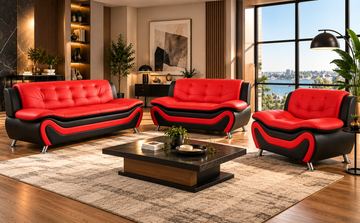
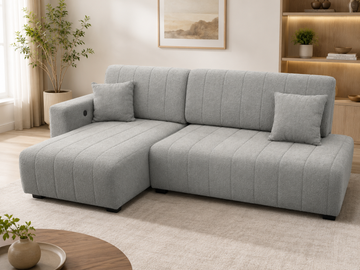


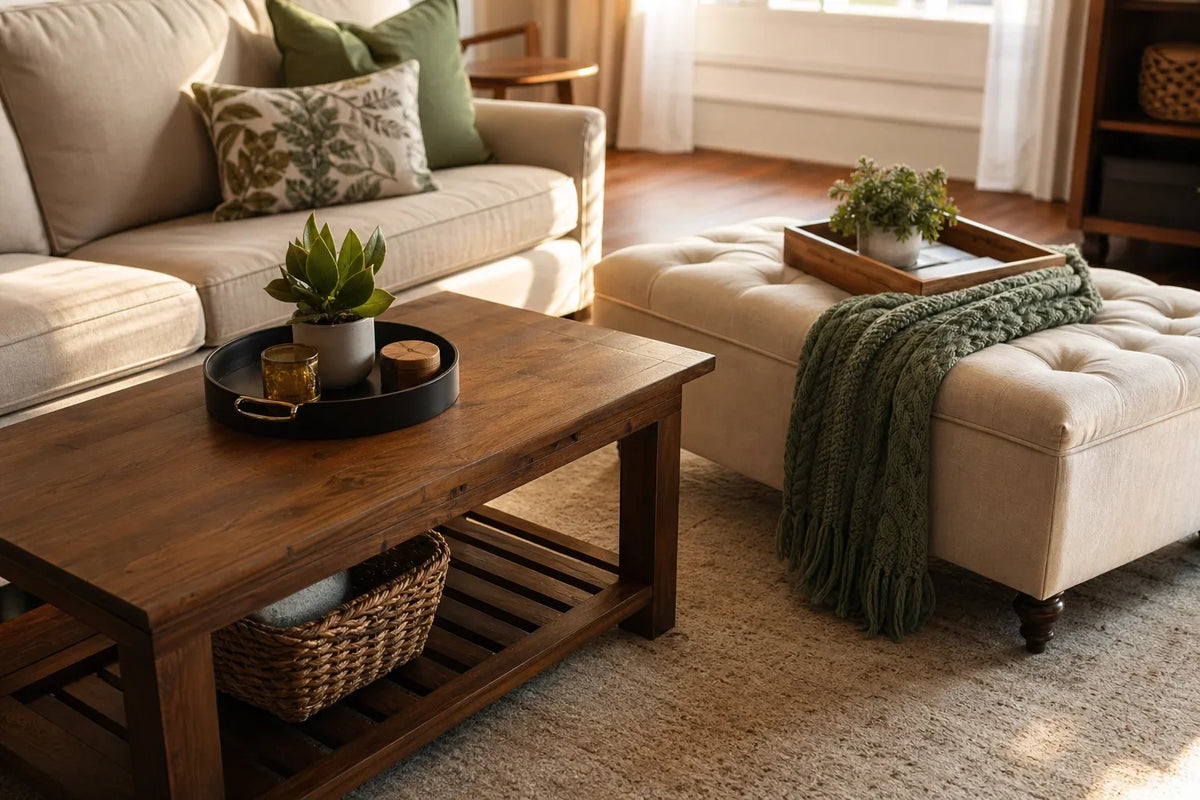
Storage Ottoman vs. Coffee Table: Which Works Better Every Day?
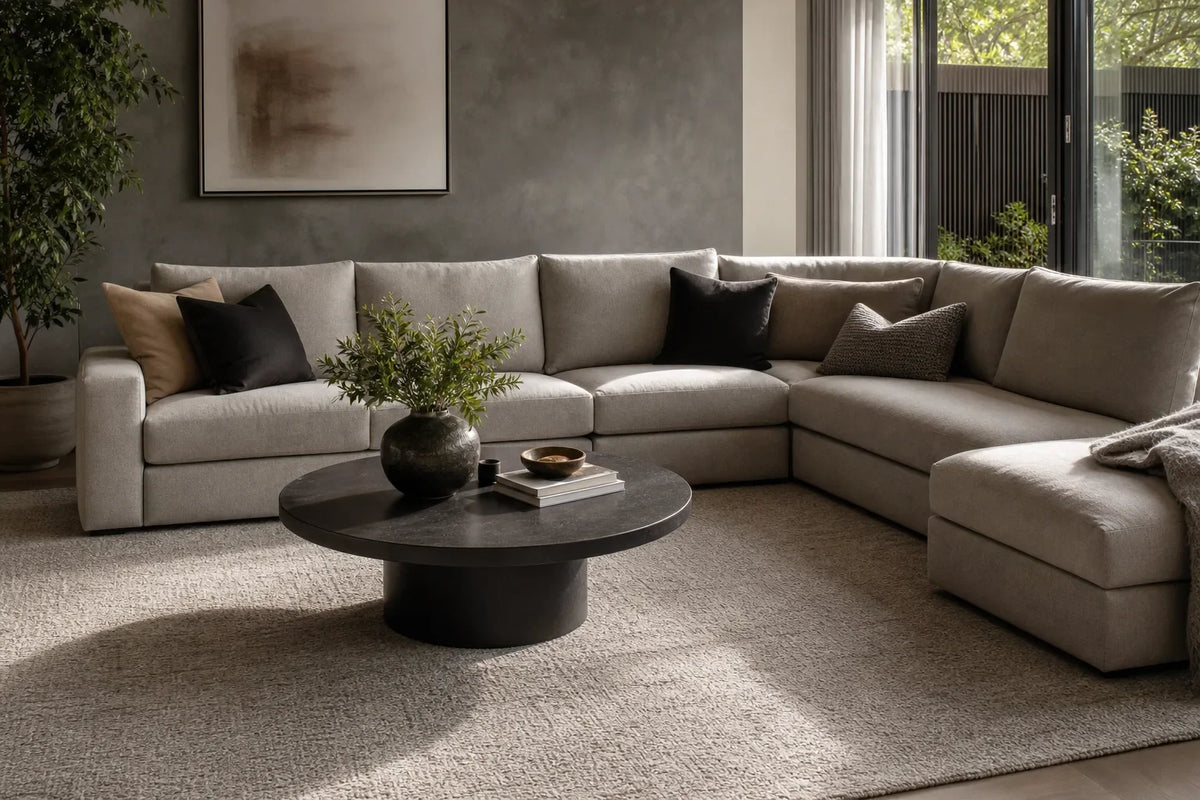
Choose a coffee table if you mainly need a firm, accessible surface. Consider a storage ottoman if putting your feet up or storing soft items matters more, and its lid and upholstery suit your routine. An ottoman can perform several jobs, but a tray does not make every cushioned surface equally stable, and storage dimensions do not tell you whether the piece is suitable for seating.
Choose the main job before comparing styles
List what the furniture must do on an ordinary evening. Supporting drinks, holding a board game, storing bedding and providing an extra seat are separate requirements.
| Main use | Coffee table: check | Storage ottoman: check |
|---|---|---|
| Drinks and small plates | Surface care and reach | Tray stability on the actual cushion |
| Feet-up relaxation | Whether another footrest is needed | Height and comfort with your sofa |
| Games or activities | Clear, usable tabletop | Whether the surface stays level |
| Blanket storage | Drawer or shelf dimensions | Internal cavity and lid access |
| Occasional seating | Do not assume a table is a seat | Manufacturer's seating rating |
Design59's ottoman guide treats intended use, upholstery and size as separate choices. Use that approach to avoid buying a visually appealing compromise that misses your main requirement.
A tray is useful, but test the whole arrangement
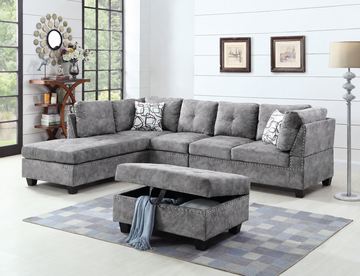
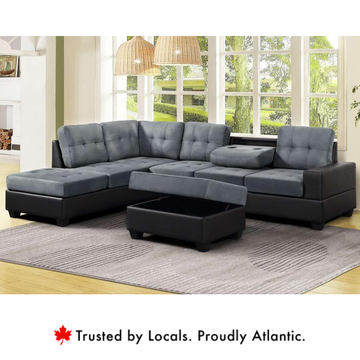
A wide, rigid tray can provide a practical surface on some ottomans. Test it on the actual top, with permission, using an empty unbreakable cup. Place it where you would use it, then sit normally on the adjacent sofa and put your feet in their usual position.
Look for tilt, rocking or a cushion seam beneath one corner. Check whether the tray moves when someone touches the ottoman. A deep buttoned surface, rounded crown or compressible cushion may be a poor match for your chosen tray.
This simple check does not certify stability. It helps identify an unsuitable arrangement before hot drinks are involved. If a dependable drinks surface is your main requirement, a separate firm table may be the better decision.
Measure the storage you can actually use
External dimensions include the frame, padding, lid and legs. The storage cavity will be smaller, and the opening may be smaller again.
Worked example: external size can exaggerate usable volume
Imagine an ottoman measuring 90 × 60 × 45 cm externally. Multiplying those dimensions gives 243 litres of bounding-box volume. That figure is not its storage capacity.
If the measured internal cavity is 72 × 42 × 25 cm, its simple rectangular volume is 75.6 litres:
72 × 42 × 25 ÷ 1,000 = 75.6 litres
This hypothetical calculation does not account for hinges, curved corners or lining. To check real fit, measure the blanket bundle or storage bag you intend to put inside, then confirm it passes through the opening. A larger cavity is not useful if the item will not fit through the lid.
Check how often you need to open it
A removable lid needs a temporary landing place. A hinged lid needs its specified opening clearance. A tray of objects must usually move before you reach either type of storage.
Try the complete sequence: remove the tray, open the lid, retrieve the blanket, close it and replace the tray. If you would repeat that several times a day, decide whether the extra steps suit you. Storage used once a week can tolerate more effort than storage used every evening.
Keep fingers away from hinges and follow the manufacturer's lid instructions. Do not assume a storage ottoman is intended as a children's toy chest or that its lid mechanism has child-specific protection.
Match height to the activity
For footrest use, sit on your sofa with the ottoman at the proposed distance. Check your leg position and whether the edge presses uncomfortably. For drinks and plates, assess the surface height and reach instead.
Our coffee-table height guide covers the table comparison. An ottoman's padded top may compress under use, so do not assume its unoccupied height tells the whole story.
Confirm seating permission and upholstery care
Do not sit on a coffee table or use an ottoman as a seat unless the manufacturer intends it for that purpose. Ask for the load rating and any conditions, including whether weight must be distributed across the top.
For upholstery, check whether a cover is removable, what cleaning method is allowed and whether the storage interior can be cleaned. Choose according to the care instructions you can realistically follow. A removable cover is not automatically machine-washable.
Decide which compromise you will notice least
Choose the piece that handles your main task well. An ottoman plus a small separate drinks surface may suit a feet-up household. A coffee table plus another storage location may suit frequent meals or games. If neither arrangement fits, leaving more open floor space is a valid outcome.
Compare current ottomans and coffee tables, then confirm storage dimensions, seating suitability and care instructions for the exact model. Availability of any particular function varies by product.